 AI
AI
What Claude Code Gets Wrong About Context
Claude Code rewrites its system prompt on every release, including tool definitions. It silently removes tools between versions and injects reminders mid-context tagged as “may or may not be relevant,” which confused Zechner’s models and broke his workflows. There is no visibility into what the agent is doing, no model choice, and hooks so shallow that each fires a new process rather than wiring into the running harness.
Open Code prunes tool output past a token threshold, which Zechner calls a lobotomy. Its LSP integration injects compiler errors after every edit instead of waiting until the work is done.
Pi: A Minimal Agent That Modifies Itself
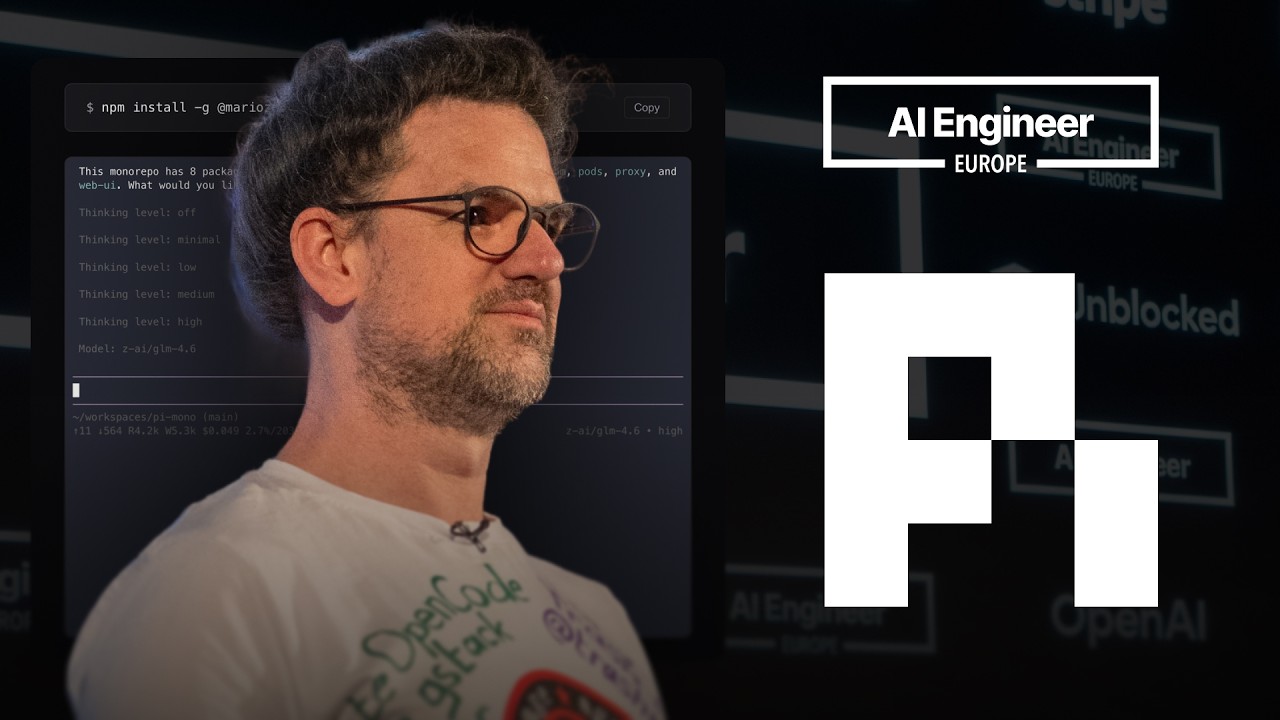
Pi ships with four tools, a system prompt short enough to fit on a single slide, and documentation plus code examples that let the agent write its own extensions during the session. Extensions are TypeScript modules. Point Pi at a file, and it gains new tools, slash-command shortcuts, custom compaction, and full hook access, all hot-reloaded without restarting. The agent does not need 10,000 tokens of instructions because models trained as coding agents already know the job.
“It’s an agent that adapts to your workflow instead of the other way around.” — Mario Zechner
He ran Pi against the terminal bench leaderboard (10:25) before adding compaction. It placed sixth.
AI-Generated Pull Requests Are Breaking OSS Maintenance
When Peter embedded Pi as OpenClaw’s agentic core, Pi’s issue tracker filled with garbage pull requests from agent instances running without user awareness. Tldraw closed its tracker entirely. Zechner’s response: auto-close every PR and ask the author to post a short issue in their own voice. Agents never come back to do that. Human contributors do, and their account names get added to an allowlist. He also labels issues from known agent interactions and built a tool that embeds PRs into 3D space to spot clusters of automated submissions.
Agents Compound Errors Without a Human Bottleneck
Agents compound errors without a natural bottleneck. A human hits pain and stops. An agent keeps writing. Models learned their patterns from the internet, 90% of which is old garbage code, so every gap in a spec gets filled from that pool. Two humans and 10 agents produce enterprise-grade complexity within two weeks. The codebase grows past any context window, search fails, and the agent patches locally while making things worse globally.
“You know what we call a sufficiently detailed spec? It’s a program.” — Mario Zechner
Modularize so the agent sees everything it needs. Give it scoped tasks with an evaluation function. Read critical code yourself and write important logic by hand.
Notable Quotes
It’s an agent that adapts to your workflow instead of the other way around. Mario Zechner · ▶ 5:59
You know what we call a sufficiently detailed spec? It’s a program. Mario Zechner · ▶ 14:19
Clankers are destroying oss. Mario Zechner · ▶ 10:59
Key Takeaways
- Pi uses four tools and a minimal system prompt, letting the agent write its own extensions in the session.
- Agent-generated PRs now flood OSS trackers; filtering for human authorship is an active maintenance task.
- Unbounded agentic output compounds errors faster than any review process can catch them; read the critical code yourself.