 AI
AI
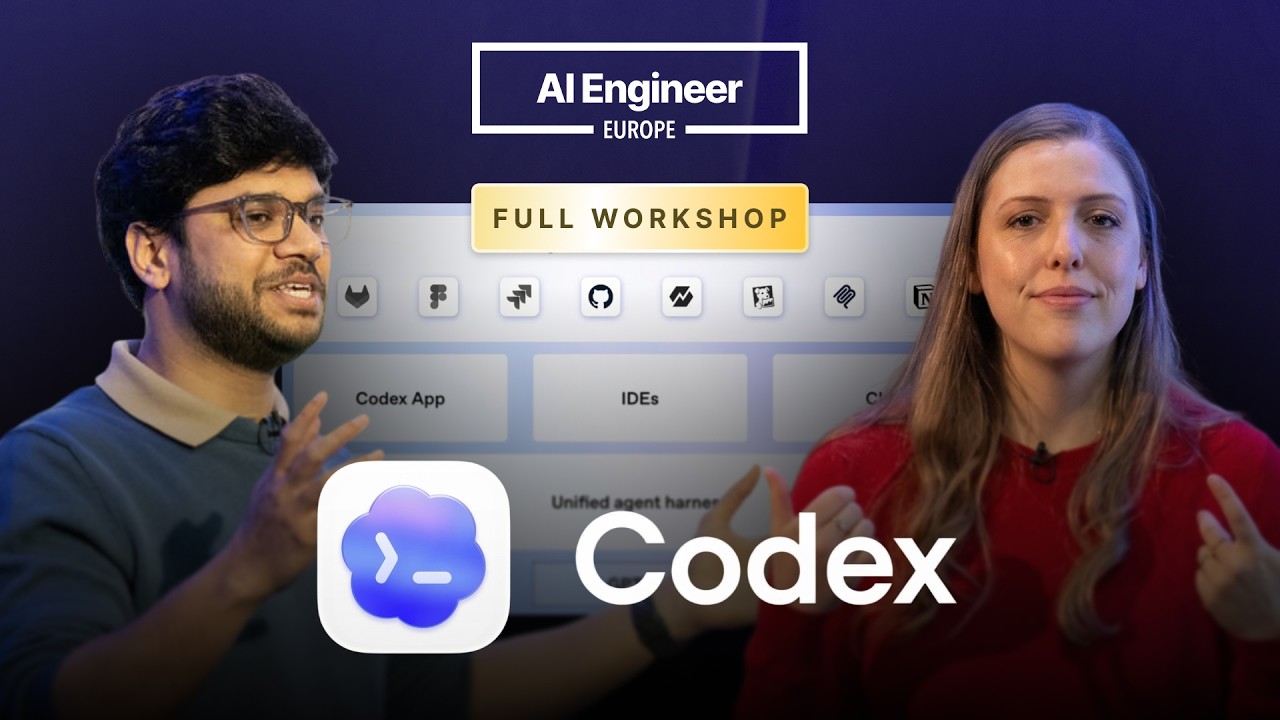
Codex Architecture and the Model Lineup
Codex is OpenAI’s software engineering agent. It runs commands, tests code, and reads entire codebases. The model line runs from GPT-5.2 through GPT-5.4, with GPT-5.3 Codex Spark built in partnership with Cerebras for speed. GPT-5.4 mini and nano handle short tasks and sub agents. WebSockets give 1.75x throughput; fast mode doubles that again. On top of the model, a unified agent harness manages tool execution, environment setup, and safety. The app, IDE extension, CLI, and Slack integration all share this harness.
“crossing 3 million weekly active users” — Vaibhav Srivastav
Plugins and Automations
Plugins bundle skills, MCP servers, and app connections into one installable unit. Skills package repeated instructions. Apps connect to services like Notion or Linear. In the game studio plugin demo (16:23), Codex built a working platformer using Imagen to generate custom sprites and Playwright Interactive to visually test each iteration, with zero manual asset work. A second demo read 57 YAML event entries from the codebase and updated a Google Sheets spreadsheet via the Google Drive plugin (23:09) in two minutes. Automations run these same operations on a cron-style schedule, like a daily 9 a.m. Slack digest.
Code Review at Scale
When Codex works across multiple parallel worktrees, reading every diff manually becomes impractical. Codex code review runs on GitHub, the CLI, and the Codex app via /review. It spins up a separate Codex process with a dedicated review system prompt, reads the full repository context beyond the diff, and surfaces second-order effects in modules the PR never touched. At OpenAI, 100% of pull requests across all repos, including those from Greg Brockman, go through Codex code review as the default first pass. A Claude Code plugin, shipped last week, brings the same review into Claude Code sessions.
Sub Agents: Parallel Task Decomposition
Sub agents split one task into independent parallel workstreams, each running in its own Codex environment. The orchestrator plans, partitions files, spawns workers, and collates results. In the 20 sub agents review demo (36:24), Codex detected the task as complex, entered plan mode automatically, and assigned TOML files across agents to review all 45 persona files simultaneously.
“There are 45 curated persona files” — Vaibhav Srivastav
Each sub agent gets a defined model, reasoning effort, and sandbox mode: read-only for security reviews, write access for doc generators. MCP servers and skills can extend individual agents further.
Extending Codex: Custom Agents and Safety Features
Guardian Approvals replaces always-on yolo mode.
“literally whatever the hell it wants” — Vaibhav Srivastav
When Codex needs a privileged action, a sub agent evaluates whether human approval is required, routing most actions through automatically and reducing interruption fatigue. The guardian approvals demo (50:07) shows the flow live. Hooks fire Python scripts on three lifecycle events: session start, each tool use, and session stop. A stop hook can instruct Codex to keep running until a long task finishes. Codex Security scans GitHub repos commit by commit, generates a vulnerability patch, and applies it.
Q&A
How do you scan past sessions to get sub agent and automation recommendations? All sessions live in a .sessions folder inside the Codex project directory; ask Codex via the app or CLI to scan them and recommend automations or sub agents. ▶ 57:25
Is there a way to hand off a task to a cloud agent when you close your laptop? Yes — select cloud mode in the Codex app or IDE extension, choose how many parallel runs to spawn (best-of-N), and Codex runs the task remotely. ▶ 58:25
Are sub agents and local skills supported in the cloud UI? Sub agents are not yet supported in cloud tasks; local skills that execute scripts are blocked because the cloud sandbox cannot verify whether a skill is trusted. ▶ 59:28
Notable Quotes
crossing 3 million weekly active users Vaibhav Srivastav · ▶ 11:38
There are 45 curated persona files Vaibhav Srivastav · ▶ 36:55
literally whatever the hell it wants Vaibhav Srivastav · ▶ 50:40
Key Takeaways
- Codex’s unified agent harness runs GPT-5.4 with WebSockets delivering 1.75x faster token throughput.
- Sub agents decompose complex tasks into parallel workstreams, each running in its own sandboxed Codex environment.
- Guardian Approvals replaces yolo mode: a sub agent vets each privileged action before execution, reducing approval fatigue.