 AI
AI
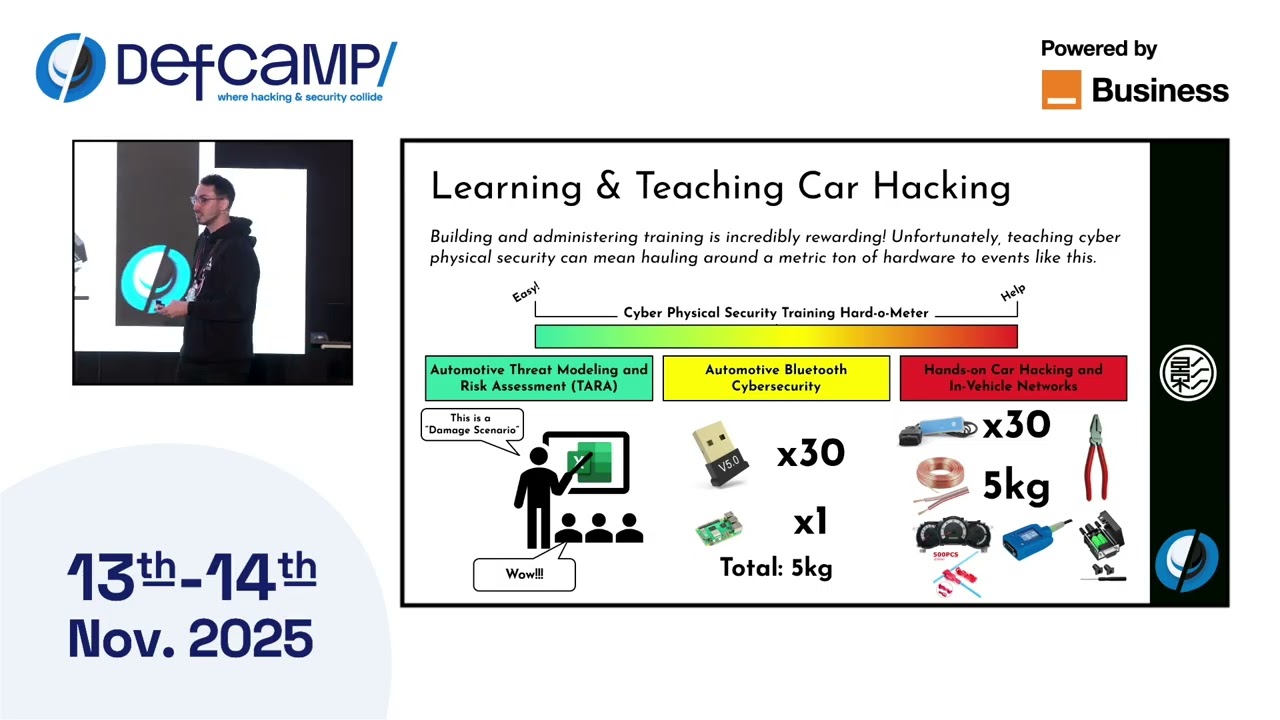
Why IoT and automotive security is hard to learn without hardware
Learning IT security takes a laptop. Platforms like PicoCTF and Portswigger Academy are free. Cyber-physical security is different. ECUs are not small. Five of them fill a garage. Add CAN bus adapters, LIN bus interfaces, Bluetooth dongles, ZigBee devices, and the list keeps going. Ghali hides hardware under his bed because he has no garage in Tokyo. No comparable online platforms exist.
“if someone hacks your car or your pacemaker or another medical device that you rely on to live, the consequences could be, you know, fatal” — Kamel Ghali
UN R155 now forces automakers selling in the EU to hold type approval and demonstrate a cyber security management system. Real compliance requires real vulnerabilities found on real hardware, hardware most researchers cannot afford or store.
The real costs of accessing hardware for research and training
Shipping hardware to a researcher means accepting it gets lost, intercepted, or bricked. Export controls on automotive components can make the shipment illegal. Flying researchers in costs hotels, flights, and a premium day rate, with no guarantee they find anything. From the manufacturer’s side, unsupervised access creates unknown exposure: find three vulnerabilities, report two, keep one.
Bug bounty competitions make it worse. Pwn2Own Automotive 2026 lists a Kenwood head unit as a target: $1,400, US-only. The $20,000 prize must absorb the device cost, a Tokyo flight, and a hotel before the researcher nets a dollar.
How a COVID-era Zoom workaround became the seed of Project Shadow
During COVID, Japan banned in-person gatherings. Ghali’s team had a Wi-Fi and Bluetooth CTF booked for the Japanese automotive ISAC — executives setting car security policy, scattered across different companies and cities. Shipping hardware was out. SSH from corporate-locked PCs was blocked. The fix was Zoom’s remote desktop control: each participant joined a breakout room and SSHed into a Raspberry Pi through Zoom screen share (25:10) to complete the lab.
“Did it suck? Yeah. But it worked” — Kamel Ghali
That planted the question: what if it didn’t suck?
Project Shadow: remote access to instrumented real hardware
Shadow stands for Secure Hardware Attack and Defense Operational Warehouse. The Tokyo lab stocks real IoT, automotive, and medical hardware, each device pre-wired with every interface it supports: CAN, Bluetooth, USB, JTAG, SPI. Researchers connect through a browser over VPN and get a terminal, automated testing scripts, firmware downloads, and a camera feed for devices with a visual component. Ghali recorded himself doing the CAN injection demo video: remote instrument cluster (31:04) from Kyoto, reading live CAN data and injecting a spoofed speed value into a physical instrument cluster sitting in Tokyo.
Live platform demo and known limitations
Ghali logged into shadow.kage live and walked through the Shadow platform demo: browser login and program dashboard (32:29), showing bug bounty and pentest program listings, per-program access controls, and a risk response policy configuration where manufacturers set TARA-based severity ratings and terms of use before a researcher can touch the hardware.
He was direct about the limits. Remote access cannot replace physical proximity for chip-whispering, voltage injection, or other close-contact attacks. Multi-user scheduling is still in development. Latency depends on where the nearest lab is, so the plan is to build nodes in the United States, Europe, and the Middle East alongside the existing Tokyo lab.
Q&A
What measures can be taken to secure car software against hacking? Ghali cited cryptographically signed firmware images, secure boot to block unsigned installs, and message authentication codes or encryption on network traffic as the primary controls. ▶ 35:54
How does the platform handle firmware reflashing when a new user connects? The platform reflashes the device to a clean state on each new user connection; for state-of-the-art hardware, Shadow works under contract with the manufacturer, who supplies the known-good firmware image used to restore the device after testing. ▶ 38:21
Have you thought about including autonomous driving hardware — LiDAR and related sensors — in the platform? Yes — Ghali confirmed they can instrument autonomous sensors and already support Automotive Ethernet, FlexRay, and CAN FD, but replicating a full sensor environment depends on what the partner manufacturer can provide for simulation. ▶ 41:16
How are you handling the relationship with manufacturers who resist opening up to ethical hackers? Ghali said the resistance comes down to cost: security by obscurity is cheaper than real investment, so regulations like UN R155 that attach financial consequences to poor security are pushing manufacturers to engage, but legislation alone cannot replace real hackers finding real vulnerabilities. ▶ 42:56
Notable Quotes
you don’t really know how you know well you know it until you develop a way to help someone else learn it from zero Kamel Ghali · ▶ 7:10
Did it suck? Yeah. But it worked Kamel Ghali · ▶ 26:58
if someone hacks your car or your pacemaker or another medical device that you rely on to live, the consequences could be, you know, fatal Kamel Ghali · ▶ 13:42
it costs money and and investing time into security and supporting security research and making a very secure product is more expensive than doing security by obscurity Kamel Ghali · ▶ 43:40
Key Takeaways
- Hands-on access to physical hardware is the single biggest barrier to entry in IoT and automotive security — address it structurally, not individually.
- Remote instrumented labs can replace hardware shipping and in-person logistics for most training and bug bounty use cases.
- Regulations like UN R155 create manufacturer incentives for security investment, but only real hackers on real hardware find the actual vulnerabilities.
About the Speaker
Kamel Ghali
A seasoned expert with over eight years of experience in automotive cybersecurity. He has worked across the U.S. and Japan as a vehicle penetration tester, security consultant, and trainer. Currently serves as Vice President of International Affairs for the DEF CON Car Hacking Village, leading global outreach and awareness efforts in vehicle security. Kamel has deep expertise in cyber-physical systems security and is fluent in English, Arabic, and Japanese. Passionate about transportation cybersecurity, he actively engages with communities worldwide to promote education and awareness in this vital domain.