 AI
AI
The Threat Modeling Landscape — No Framework Rules Them All
No single threat modeling framework covers every case. FIRST’s special interest group mapped STRIDE, PASTA, LINDDUN, and others against industry verticals and found no framework scored zero — all are useful to some degree, but for different reasons. STRIDE is developer-friendly and easy to run in a workshop. PASTA is more involved and speaks to business risk. MITRE ATT&CK targets TTPs and attack chains. Singapore’s Cyber Security Agency landed on combining STRIDE and ATT&CK: STRIDE defines what property is violated; ATT&CK answers how the attacker does it. The practical rule is to mix frameworks to match your audience and outcome, not to find the one that rules them all.
STRIDE + MITRE ATT&CK — Building a Combined Threat Table
STRIDE maps the loss of security properties. MITRE ATT&CK maps the TTPs attackers use at each stage of the kill chain. Cheah combined both into a single color-coded table, walking through the MITRE ATT&CK + STRIDE combined threat table for an on-prem web app (10:08) against a simple on-premises web application. Each row answers four questions: who the attacker is (insider or external), what they do, where they execute the threat, and how. That structure lets you zoom in quickly when deciding whether a given threat is worth mitigating.
Cloud Threat Modeling — Shifted Impacts and New Considerations
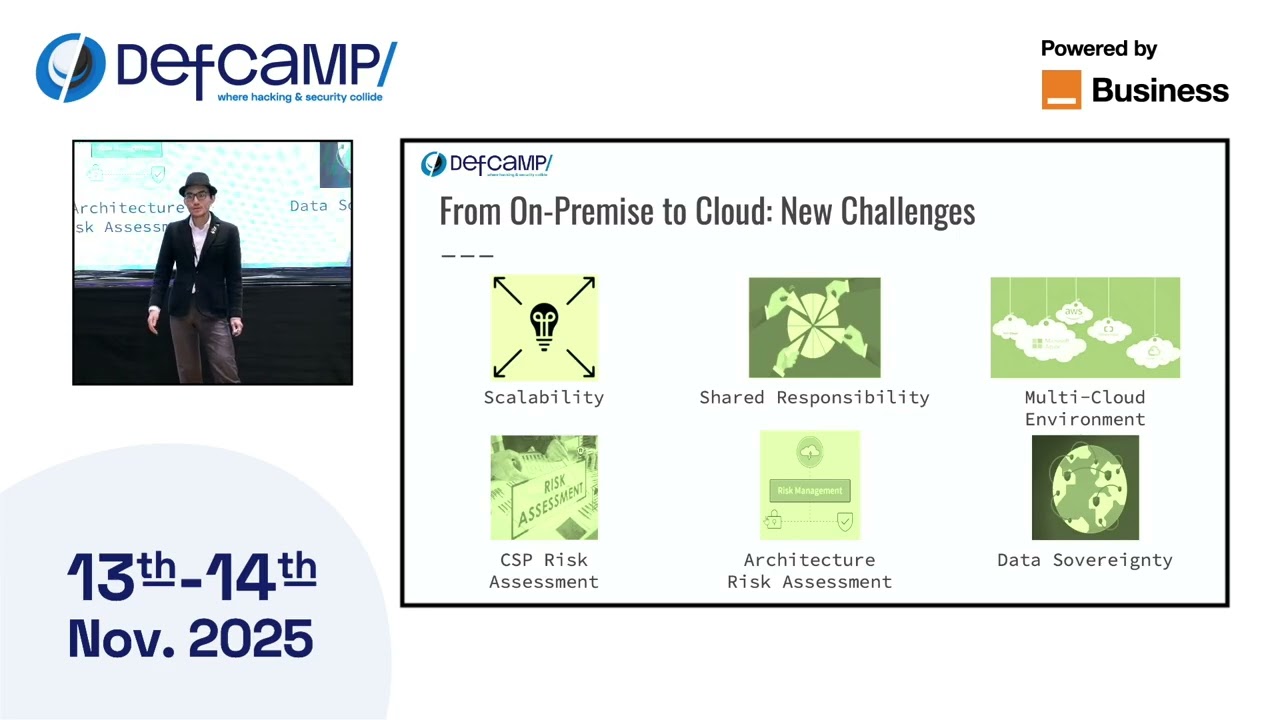
Cloud changes what “impact” means. A crypto miner exhausting an on-premises server takes the server down. The same attack against a cloud workload sends someone a very hefty bill. Scalability and shared responsibility shift threat impact in ways that on-premises models miss entirely. That is why the CSA ENISA 11 exists — 11 top cloud pain points — and why MITRE publishes separate IaaS and SaaS matrices. Once threats are catalogued, MITRE D3FEND closes the loop: it links each ATT&CK technique to countermeasures and observable artifacts, as Cheah showed in the MITRE D3FEND SMB relay example (16:15), tracing an SMB relay TTP through red attack boxes to blue defensive controls.
PASTA — Risk-Driven Threat Modeling Across Seven Stages
PASTA runs seven stages: define objectives, define technical scope, decompose the application, analyze threats, map vulnerabilities, model attacks, and quantify risk. Each stage feeds into the next. STRIDE and MITRE ATT&CK slot into stage four — you pick whatever framework fits. The final stage produces a board-ready risk report, which is most of what the job actually requires.
The framework demands up to 15 distinct roles. Cheah acknowledged most teams are resource-strapped and one person covers several. What matters is knowing which role you’re filling, because those roles map to a RACI matrix that keeps accountability clear across a process where everyone bears some responsibility.
AI-Assisted Threat Modeling — Capabilities, Limits, and Tooling
LLMs can generate threat models, but only to a point. They work as brainstorming aids (surfacing standard threats you might miss) but hit a hard ceiling on novel architectures.
“LLM is good at elevating your flaw of competence. Meaning to say, if you know nothing about a topic and you try to interact with it, it will give you some sort of direction to search. That does not mean that you are an expert at a topic.” — Donavan Cheah
“please do not expect LLM to do your job. It is not going to give you novel attack vectors.” — Donavan Cheah
Tools like Threat Canvas go further: Cheah referenced the Threat Canvas LLM-generated DFD demo (30:00), where an LLM generates a data flow diagram from a prompt. The output needs expert refinement. Modify the DFD, recontextualize its elements, then revise the enumerated threats against what you actually know about the system.
Threat Modeling AI Systems — Probabilistic Outputs and the Layer Model
Traditional threat modeling assumes a deterministic system: same input, same output. AI breaks that. Run 100 jailbreak attempts against one LLM and you get probabilistic results.
“if you input something you will get a deterministic output right and because of that you know with certainty what’s going to happen to an application unfortunately AI systems are not like this” — Donavan Cheah
Two responses are emerging. A layer model threat-models foundational components separately from data operations, then traces an AI kill chain across layers. Project Guardrail is a questionnaire that sets design-level limits for developers. If engineers can’t answer half the questions, the team doesn’t know what it deployed. MITRE ATLAS covers the TTP inventory. The harder problem is prompt injection: enough creative manipulation may always find a path, and some threats may not be eliminable.
Q&A
How do you bridge the gap between security engineers who don’t know the application and developers who aren’t security-aware during threat modeling sessions? Cheah framed it as an organizational and political problem, not a technical one — the DFD exercise forces shared understanding, but selling that to teams requires communication skills outside the scope of threat modeling itself. ▶ 42:28
How can PASTA-based threat modeling be done faster when the process is tedious and involves many roles? Cheah recommended time-boxed, facilitated workshops with post-it exercises to get everyone contributing without demanding perfect answers, aiming to make participants realize how their work affects others. ▶ 45:06
How do you prioritize which threats to include in a threat model — APT groups, past breaches — and how often should threat modeling be done? Cheah said relevance to your sector and known organizational practices should drive prioritization, declined to give a number, and offered to follow up privately because he is currently working on integrating threat modeling with threat hunting and CTI to solve exactly that problem. ▶ 47:32
Notable Quotes
LLM is good at elevating your flaw of competence. Meaning to say, if you know nothing about a topic and you try to interact with it, it will give you some sort of direction to search. That does not mean that you are an expert at a topic. Donavan Cheah · ▶ 29:19
please do not expect LLM to do your job. It is not going to give you novel attack vectors. Donavan Cheah · ▶ 29:47
if you input something you will get a deterministic output right and because of that you know with certainty what’s going to happen to an application unfortunately AI systems are not like this Donavan Cheah · ▶ 32:29
if you can’t get a data flow diagram out, then maybe the short answer is that it is unclear to everyone and there’s some gaps and so this exercise helps Donavan Cheah · ▶ 43:42
Key Takeaways
- Pick threat modeling frameworks by purpose and audience — no single framework covers every scenario.
- Start threat modeling before production; discovering egregious flaws post-launch leads to no happy conversations.
- Treat AI as a brainstorming floor-raiser, not a threat model generator — always recontextualize LLM output against your actual system.
About the Speaker
Donavan Cheah
Donavan has eight years of experience in speaking both the technical language of offensive security (red teaming, pentesting), the architectural language of threat modelling and the business language of risk, both cybersecurity and business risks. As a cybersecurity consultant, Donavan has a deep understanding of the businesses and operations in multiple sectors, including government, aviation, transportation, defence and financial sectors. He excels at identifying key cybersecurity solutions to enable companies to achieve 3 “C”s: compliance with regulations, confidence in the company’s cybersecurity posture and cost-effectiveness to ensure companies pay only for what they need at their level of cyber maturity. He has contributed to the open-source cybersecurity community, such as his series of deliberately vulnerable machines on Vulnhub from 2018 to 2021. He has also conducted talks on both technical and strategic cybersecurity topics at multiple conferences and venues regionally (Mystikcon, Vulncon, Division 0), as well as to non-cybersecurity audiences. Donavan also possesses multiple certifications ranging from Offensive Security certifications (OSCE3, OSCP), ISC2 (CISSP), ISACA (CRISC) and is a Masters in Cybersecurity (Online) student at Georgia Tech.