 AI
AI
From Metalot BBS to the Hacker Manifesto
Phrack launched in 1985 on the Metalot BBS, before the web. Early issues focused on phone phreaking and pirated software. The E911 paper drew Secret Service attention in 1991, leading to a raid and the creation of the EFF. Charges were dropped. The Legion of Doom era followed, covering x25 and AMPS mobile networks. Smashing the Stack for Fun and Profit debuted in 1996. Heap exploitation, format string attacks, and living-off-the-land techniques appeared in the 2001-2005 era.
The Takeover: From tmp.0ut to Phrack Staff
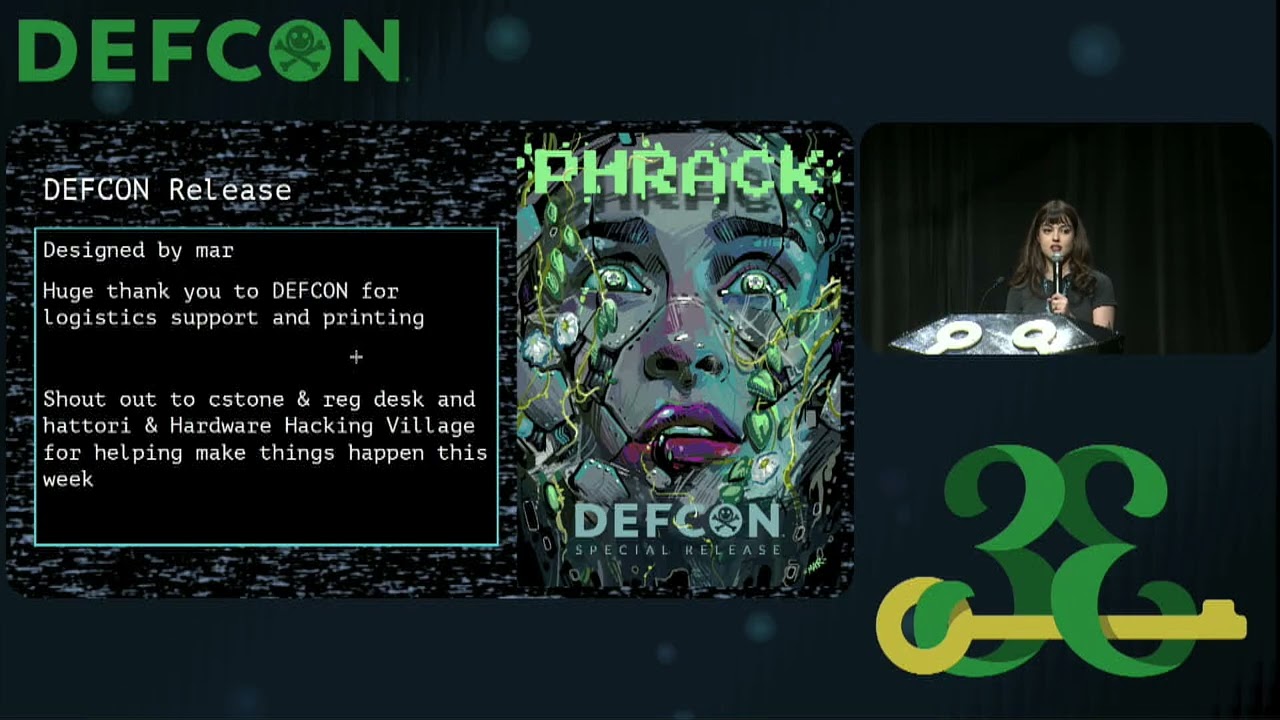
Netspooky ran the elf virus zine tmp.0ut with Rich and Chompie. Grugq reached out and offered the Phrack staff role. “Imagine if Berghain saw your DJ stream with four viewers and said, ‘Want to run our club?’” They said yes. The new team learned magazine layout from scratch. At Defcon 2024 they printed 500 copies. The positive reception led to a CFP in January 2025, extended to June, to grow the team and find authors.
Issue 72: 15,000 Copies and a Cross-Conference CTF
Phrack 72 accepted 16 mainline papers and 8 line noise entries. The print run reached 15,000 copies across four covers: Defcon, Y, Hope NYC, and a Netspooky design for online orders. Future runs include HitCon Taiwan, Dragon Jarcon Colombia, and Alligator Con. A collaborative CTF with two binary exploitation challenges—one Linux, one Windows—requires owners of both the Defcon and Y issues to combine QR codes. Only the Linux challenge had been solved as of the talk. The winner gets a Phrack coin and an early release of issue 72.
Overcoming Imposter Syndrome
The most common reaction from potential contributors was “I couldn’t possibly write for Phrack, I’m not good enough.” The second most common: “What is Phrack?” The staff’s message: “If not you, who? If not now, when?” They encouraged next-generation hackers to submit. Many young researchers didn’t know Phrack existed; the talk served as outreach. The staff emphasized that Phrack is the community, not any single person, and that rolling submissions are always open.
Q&A
How has exploit commercialization impacted publications like Phrack? Commercialization is an unstoppable force that changes incentives, but the Phrack spirit of community sharing and giving back remains distinct. ▶ 31:05
What has you all excited about hacking right now? The future lies in hybrid attacks spanning software, hardware, microcode, and AI; new platforms like robots and LLMs have immature security and create fresh ground for exploitation. ▶ 36:18
Notable Quotes
I couldn’t possibly write for frack I’m not good enough Netspooky · ▶ 09:41
if not you who if not if not now when Netspooky · ▶ 10:16
I owe pretty much my entire career to Frack richinseattle · ▶ 22:58
commercialization is like this force that is like it’s an unstoppable force CTS · ▶ 32:51
Key Takeaways
- Phrack 72 printed 15,000 copies and accepted 24 articles across two tracks.
- A cross-conference CTF requires collaboration between Linux and Windows exploiters.
- The new staff transformed tmp.0ut’s zine experience into Phrack’s largest release.
About the Speaker(s)
richinseattle grew up reading Phrack on BBSs and now is lucky enough to be included as part of Phrack Staff. richinseattle is also known for his Undercurrents(.io) BBS, co-founding Uninformed Journal, and doing a bunch of talks at Defcon, Black Hat, and others.
Netspooky is a security researcher and artist. He works on hacking zines Phrack & tmp.0ut, and runs the annual Binary Golf Grand Prix file format hacking party.
Chompie is a security researcher, exploit developer, and weird-machine mechanic. She leads X-Force Offensive Research (XOR). In her free time, she volunteers on Phrack Staff and other initiatives that support the hacker community.