 AI
AI
Military-Civil Fusion: Why Medical Data Becomes a Hacking Target
China’s military-civil fusion doctrine explains why academic and commercial medical data becomes a state-sponsored hacking target. When a commercial goal wraps into a national security goal, it becomes eligible for state-backed cyber operations. The pattern is established across sectors: shipbuilding, semiconductors, vaccines. Medical big data follows the same logic. Once bioinformatics touches population health, fertility, or aging, it stops being just research and starts being a national security input.
China’s Upstream Playbook: Medical Data as the Biotech Mine
China’s development playbook targets upstream inputs. The electric vehicle case shows the pattern: controlling mineral mines and batteries came before building the cars. For biotech, the 14th Five-Year Plan’s bioeconomy section flags “big medical data integration” as the critical upstream input. Medical data mines are individual health and genetic records. Control those, and pharmaceutical and biotech researchers have to come to you, training your workforce and transferring IP in the process. Precision medicine and cancer treatment sit downstream. Medical data is the mine.
Structural Advantages in Data Collection
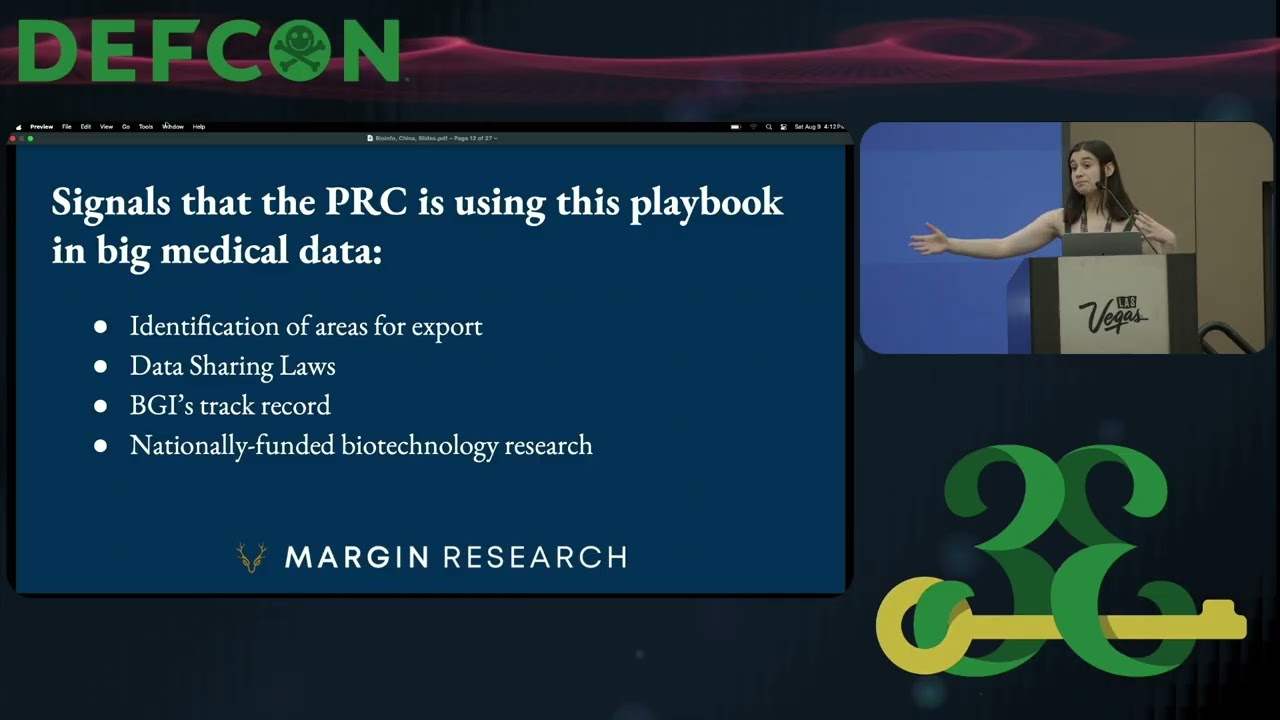
HIPAA prevents U.S. medical providers from consolidating patient records across institutions. China has no equivalent restriction and mandates that health data collected inside China go to the government and stay there. BGI exploited this asymmetry: the company set up U.S. fertility clinics and collected genetic data through free prenatal tests, sending it back to China. China’s national research funding reinforces the picture. Animal and human genetics commands outsized budget in both China’s NSFC and its national lab system, a specific focus that signals deliberate prioritization.
The Target Tier List
Shapiro ranks U.S. medical targets by how much China wants them. Infectious disease IP and vaccine data sit at the top because China has been caught stealing them multiple times. Below that: software for analyzing large biomedical datasets, easily formatted biomedical data that ingests without cleanup, and hardware upstream of data collection like genetic testing chips. U.S. hospital data is particularly valuable because Chinese infrastructure produces lower-fidelity records. Populations genetically unlike the Chinese population, people in different climates, and patients receiving care unavailable in China all represent irreplaceable collection targets.
The DOJ Regulation and the Shift to Hacking
In July, a DOJ regulation went into effect banning export of U.S. genetic data, proteomic data, and other sensitive health information to China. Criminal charges are on the table. The rule closes loopholes that previous export controls left open. China was buying this data legally, through company investments, personnel placements, and outright purchase. Those channels are now shut. Shapiro’s prediction: a significant uptick in hacking of U.S. bioeconomy-relevant data within the following year. Paradoxically, seeing more attacks would confirm the regulations are working.
Q&A
Does China target medical data from countries other than the United States? Shapiro said her analysis focuses only on the U.S.-China dynamic and offered to follow up separately. ▶ 21:35
Would hospitals, VA systems, or government-managed labs be the primary targets? Shapiro said she lacks U.S. healthcare expertise to identify the least-protected stores, and framed the talk as giving sector insiders enough targeting context to assess their own exposure. ▶ 22:22
Given China’s increasing risk tolerance, would you expect infrastructure disruption alongside data theft? Shapiro said the interest here is in theft, so she expects government-held data repositories to become targets where previously only commercial vendors were at risk, with little motivation to disrupt the infrastructure itself. ▶ 24:20
Notable Quotes
Tail is old as time. We’ve caught Amelia Shapiro · ▶ 17:28
get it. That’s just not how they roll. Amelia Shapiro · ▶ 19:52
we’re probably going to catch something. Amelia Shapiro · ▶ 20:55
Key Takeaways
- China’s 14th Five-Year Plan explicitly names big medical data integration as a strategic upstream priority.
- BGI collected U.S. genetic data through free prenatal tests at fertility clinics before data export bans took effect.
- A DOJ regulation banning genetic and proteomic data exports will likely trigger a hacking surge within a year.
About the Speaker(s)
Amelia Shapiro is an intelligence analyst at Margin Research, specializing in combining science and technology analysis with regional expertise. Before Margin Research, she worked at a DC-based research shop. She graduated from Brown University with the Albert A. Bennett Prize for Exceptional Accomplishment in the Mathematics Concentration and honors in the security studies concentration.