 AI
AI
Why Healthcare Needs PQC Now
Post-quantum crypto is production ready, unlike homomorphic encryption. Asymmetric algorithms used in TLS and certificates are breakable by a quantum computer. The biggest threat is harvest now, decrypt later: attackers intercept encrypted data today and decrypt it years later. A graph shows medical devices at highest risk due to long data shelf life and system life cycles. MRI, CT, and X-ray machines can remain in hospitals for 30 to 50 years. Regulatory bodies like FDA already require Suite B ciphers; CNSA 2.0 includes PQC algorithms. The number of qubits is rising exponentially; 1 million physical qubits could break 256-bit elliptic curves, possibly by 2040.
Prototype: PQC in DICOM Communication
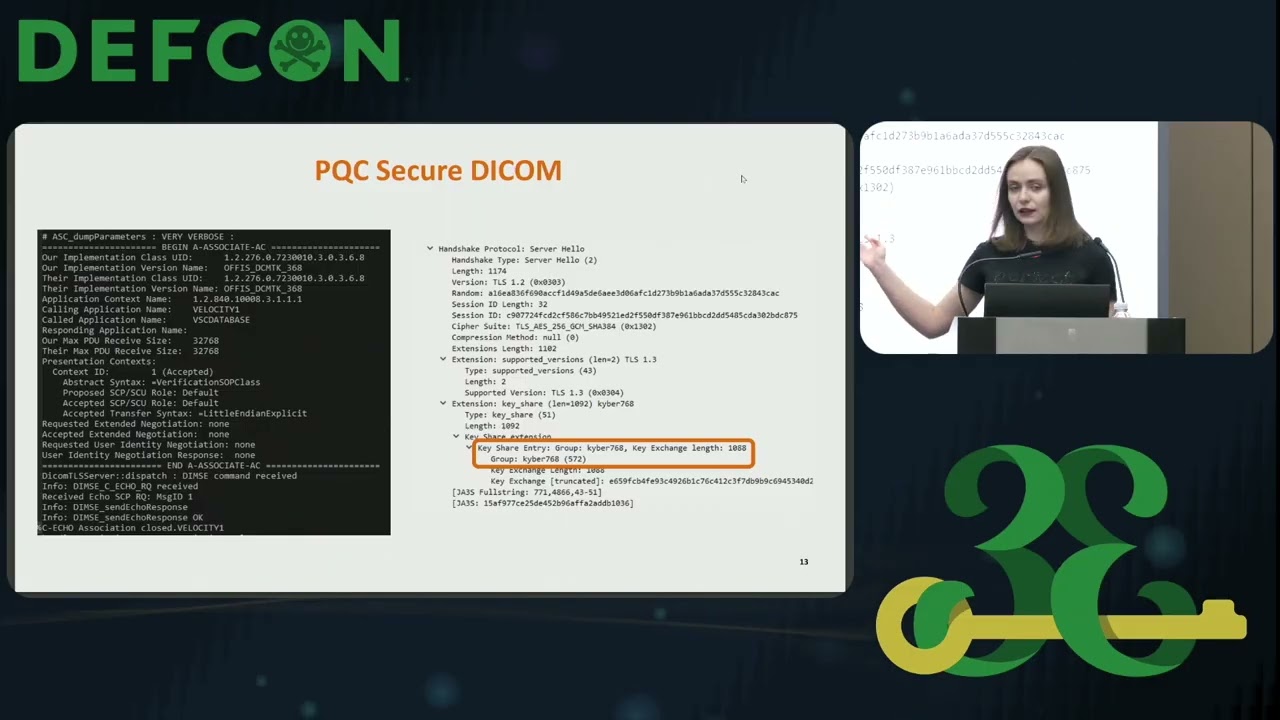
Google and Cloudflare found that 30% of their PQC communication failed because large keys did not fit into a single client hello and server hello. Middleware dropped fragmented packets. To test this in healthcare, Amrichova built a server and client communicating over DICOM protocol wrapped in TLS with PQC. She used DCMTK for DICOM, OpenSSL for TLS, and OQS provider for PQC. DCMTK expected vanilla OpenSSL, so she added a few lines of code to load the provider. The resulting handshake used Kyber768 for key exchange. She recommends a hybrid approach with stronger algorithms because PQC algorithms are new and not yet proven over decades.
Building a Cryptographic Bill of Materials
To prioritize which software to transition, a crypto bill of materials (CBOM) is needed. No ready tool exists. Amrichova built a CI pipeline combining static code analysis (SAST) and software composition analysis (SCA). The pipeline uses Sonar Crypto plugin (supports Java and Python) and CBOMkit from IBM Research. It scans the project source code and then generates dependency lists, checking if a CBOM already exists for each package. The team is helping IBM extend coverage, adding detection for Google’s Tink library in Java. Missing features include project management and user management inside CBOMkit.
Transition Timeline and Next Steps
After prototypes, the next milestone is documentation: strategic directives and guidelines that require business lines to generate CBOMs and perform threat risk analysis with quantum threats in mind. Tools must mature first. Language support is improving: OpenSSL already supports PQC, and .NET 10 will natively support PQC primitives (but not yet on the TLS layer). The ultimate goal is to ship medical devices with PQC on the market. For existing devices with long lifecycles, a wrapper or intermediate network layer could intercept TLS and convert it to PQC.
Q&A
How to handle devices already in the field that will still be used in 2045? A wrapper or intermediate network layer could intercept TLS and convert it to PQC. ▶ 25:10
Is the implementation focused on confidentiality or authentication? The prototype only covers key exchange (confidentiality) because harvest now decrypt later attacks target passive attackers; signatures for authentication will be addressed later. ▶ 26:16
Is wrapping PQC in TLS a temporary measure? TLS 1.3 already supports PQC, so the fragmentation problem from earlier experiments is resolved in the standard. ▶ 27:28
Notable Quotes
the biggest problem is the harvest now and decri later type of attacks because if the attackers um get hold of a quantum computer many years from now, for example, 10, 20, 30 years from now, they would be able to retrospectively uh decrypt all of the communication they intercepted. Katarina Amrichova · ▶ 03:27
30% of their communication was failing Katarina Amrichova · ▶ 10:29
this might be one of the first uh PQC secured icon exchanges ever. Katarina Amrichova · ▶ 14:00
Key Takeaways
- Medical devices with long lifecycles (MRI, CT) face the highest quantum risk and should transition first.
- A proof-of-concept for PQC-secured DICOM communication using Kyber768 and OpenSSL was built and tested.
- A CI pipeline using Sonar Crypto and CBOMkit generates cryptographic bill of materials to prioritize transition.
About the Speaker(s)
Katarina Amrichova has a deep appreciation for reverse engineering, exploit development and cryptography.