 AI
AI
A Yamaha CPU with No Documentation
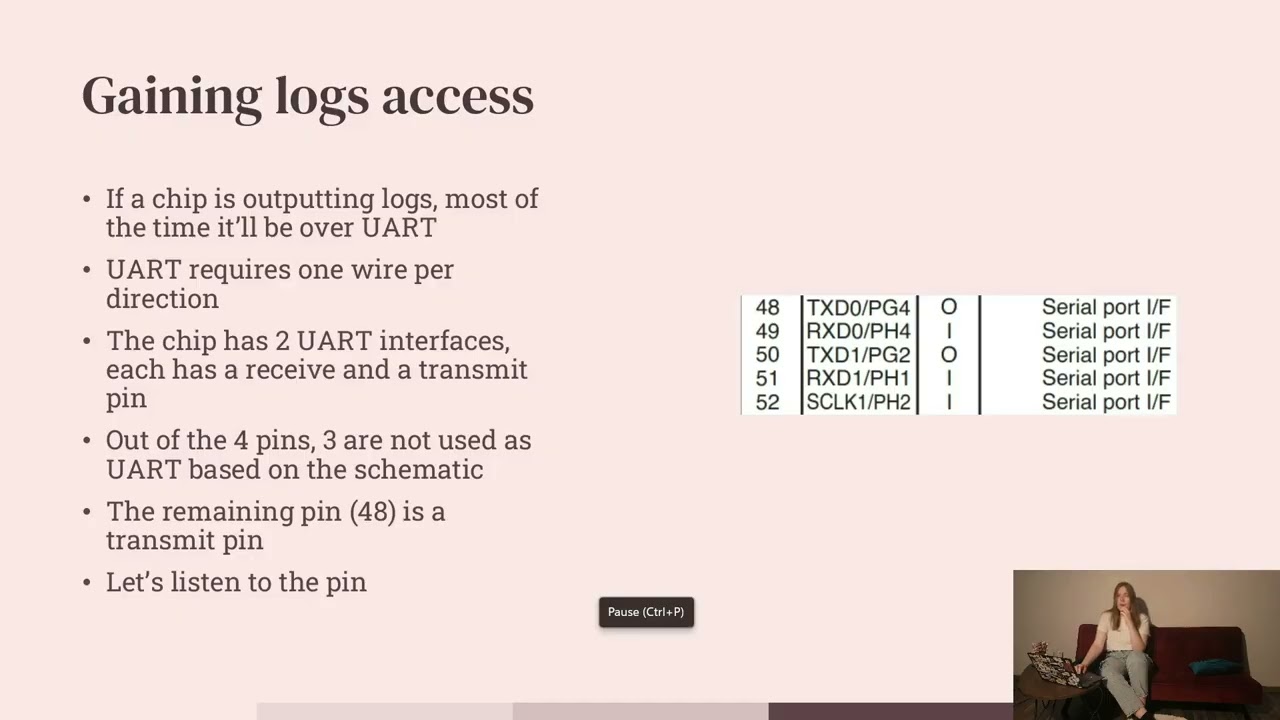
Anna Antonenko tore apart a Yamaha E433 synthesizer to clean it and found the main CPU labeled Yamaha SL1U had zero public documentation. Googling the part number returned only an AliExpress listing. Two years later she found a service manual for the similar E443 model. It included full schematics and a 176-pin CPU pinout. That pinout was the starting point for everything that followed.
Gaining JTAG Debug Access on an Undocumented Chip
Using a Chinese knockoff JLink adapter and OpenOCD, Antonenko probed the JTAG interface. The chip returned ID code 0x3F, which matched ARM7-based devices from Atmel, Analog Devices, and ST Microelectronics. Configuring OpenOCD for ARM7 worked. When she halted execution in GDB, current draw dropped from 114 to 98 milliamps. Interrupt vectors at address zero were valid ARM jump instructions. The synthesizer had no JTAG lock protection.
Extracting and Reading the Firmware
The reset vector jumped to address 0x200000, not zero. Antonenko dumped 16 MB from that address. Strings she knew from using the instrument appeared: voice names and UI messages. Playing the binary in Audacity, she heard piano, guitar, and string samples embedded in the image. She used Ghidra to connect strings to functions, propagating meaning outward through the code until she found a subsystem the firmware called a shell.
A Debug Shell Hidden in MIDI SysEx Messages
The shell ran a three-state input handler. State zero prompted for login. State one waited for a password. State two executed commands. The password was #0000000000, hardcoded in the firmware. The shell communicated over MIDI system exclusive messages using Yamaha’s manufacturer ID 0x43. MIDI prohibits bytes with the high bit set, so data was split into four-bit nibbles. Sending crafted SysEx packets over USB-MIDI was enough to reach it.
Arbitrary Memory Writes as the Exploit Primitive
The shell’s wl command wrote any 32-bit value to any RAM address. Antonenko assembled a payload in ARM assembly, encoded it as write commands, wrapped those in SysEx, and saved the result as a MIDI file. Playing the file overwrote a return address on the stack, hijacking execution. No buffer overflow search was needed. The write primitive was openly exposed by the shell.
A Decade of Yamaha Products Affected
After Antonenko published her article, community testing found the shell across a decade of Yamaha hardware. The E433 from 2012 was the earliest confirmed model. The E473 from 2022 was the latest. The GGX digital piano (2016) had the same shell and the same password. Strings matching the shell were also found in firmware for the P125 drum model. Researchers Marisa Chan, curler1846, and Centra documented findings on GitHub. Nearly every Yamaha product ships an arbitrary memory-write backdoor over MIDI.
Notable Quotes
we got it. We got the shell. Anna portasynthinca3 Antonenko · ▶ 29:02
which is hardcoded in the code Anna portasynthinca3 Antonenko · ▶ 23:26
binary exploitation 101 except we don’t Anna portasynthinca3 Antonenko · ▶ 30:39
This is a big issue I think Anna portasynthinca3 Antonenko · ▶ 37:40
Key Takeaways
- A proprietary ARM7 chip in Yamaha synthesizers exposed JTAG without any access protection.
- Yamaha firmware hides a debug shell behind a hardcoded password transmitted over MIDI SysEx.
- The shell’s unrestricted memory-write command turns any Yamaha MIDI device into a code-execution target.
About the Speaker(s)
Anna portasynthinca3 Antonenko has been building projects with Arduinos and microcontrollers since 2017, when she was 13 years old. She has worked across AVR, STM32, and ESP32 platforms. Today she works as a professional embedded firmware engineer, with interests in hardware reverse engineering, operating system development, and distributed fault-tolerant systems.