 AI
AI
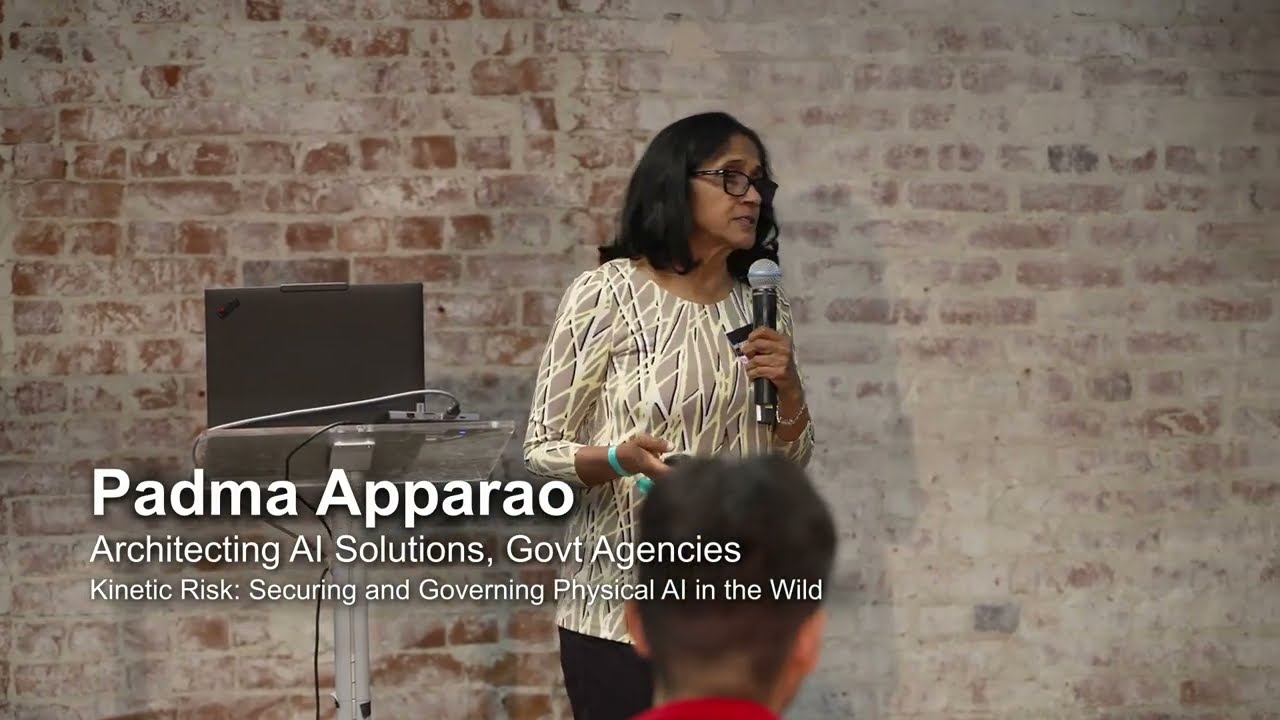
Kinetic Risk: Why Physical AI Errors Are Irreversible
Digital AI acts on information. Physical AI acts on the world. In the digital world, a bad decision gets a Ctrl-Z. In the physical world, it gets force, motion, and physics.
“When AI’s mistakes start moving into the real world, that’s Kinetic Risk.” — Padma Apparao
Errors in physical systems are not very reversible. Timing compounds this: you have to detect the mistake before the action executes. Three converging technologies — mature sensors, stable frontier models, and viable edge compute — have made large-scale physical AI deployment possible now, which means this irreversibility problem is no longer theoretical.
The Five-Layer Physical AI Stack
Physical AI runs as a closed loop with five layers: sensors gather raw data; a perception layer filters and correlates it (including flagging spoofed readings); a world model predicts what the environment looks like and what happens next; LLMs and VLMs reason and plan the action sequence; and the VLA (vision-language-action model) translates that plan into motor commands — exact arm angles, leg positions, grip force. The coffee-cup example makes it concrete: the world model determines whether the cup is ceramic or paper, whether it has a handle, where to grasp it so the coffee doesn’t spill. If that prediction is wrong, the cup gets dropped. All five layers have to work together; a miss at any one of them propagates into the physical world.
Failure Modes: Accidental and Adversarial
Physical AI fails two ways: accidentally and on purpose. A GPS telling you to make a U-turn is giving advice, not permission — it has no model of the physical world and no authority over your car. Physical AI systems have both, which means a wrong world-model prediction doesn’t just display an error; it spills the coffee, or worse. On the adversarial side, an attacker who spoofs sensors or injects a security vulnerability doesn’t cause accidental failure — they cause intentional failure through the same five-layer stack. Both paths end at the same place: irreversible physical action. That’s why fail-safe architecture isn’t optional.
Latency as a Safety Parameter and the Human-in-the-Loop Myth
The entire sensing-to-action loop in a physical AI system must complete within 100 to 200 milliseconds. VLAs (vision-language-action models) operate in the sub-millisecond range. LLMs, which everyone measures in tokens per second, run orders of magnitude too slow for that constraint. Latency is not a performance KPI here. It is a safety parameter: you can identify the correct action and still cause harm if the command arrives 10 milliseconds late.
That timing reality ends the human-in-the-loop argument. Humans operate in seconds and minutes, not milliseconds. Apparao put it plainly: you need something in the architecture that eliminates the need for humans in the execution path. Humans retain strategic authority — they set boundaries, design the architecture, define intent — but the execution runs autonomously. Requiring a human to approve each action is the same as having no physical AI at all.
Embedded Governance and the Regulatory Gap
NIST AI RMF and the EU AI Act both miss physical AI entirely. NIST covers governance, mapping, managing, and measuring, but nothing on real-time control. The EU AI Act classifies systems into risk tiers, then hands enforcement to sector regulators: hospital robots fall under medical law, not AI law. Neither framework touches runtime behavior. Governance can’t sit outside a system and paper over it. It has to be built into the architecture, enforcing timing bounds, defining physical scope, and specifying the escalation path when a system needs to halt without causing damage.
Accountability, Liability, and System-Level Certification
When a Tesla causes a fatality, the question is who to blame: the model vendor, the developer, the integrator. Liability flows up the stack to the last layer that could have stopped the action. That layer is the control system, not the sensors. The sensors just pass data. The world model only sees what the sensors give it. The control layer is the final actor, and it owns the damage.
Humans cannot share that burden in real time. They operate in seconds and minutes; the execution loop runs in milliseconds. Their role is setting boundaries before deployment, not intervening during it. That makes system-level certification the only meaningful standard. Model attestation from OpenAI or Anthropic is not enough. The entire stack must be certified. Skip governance at design time and you will encounter it later in accident reports and lawsuits. The DHS drone friendly-fire incident shows the cost: a surveillance drone shot down because two agencies failed to coordinate, a failure that embedded governance would have closed automatically.
Q&A
Is there any serious regulatory movement — in banking, energy, weapons — to govern physical AI, given that technology is innovating far faster than policy? Apparao cited the DHS drone shoot-down two days prior as evidence that governance still lags badly, then offered only that she hopes it will change — no concrete regulatory progress named. ▶ 25:35
Notable Quotes
सो, व्हेन एआईएस मिस्टेक्स स्टार्ट मूविंग इंटू द रियल वर्ल्ड, दैट्स काइनेटिक रिस्क। Padma Apparao · ▶ 1:21
लेटेंसी इज़ अ सेफ्टी पैरामीटर Padma Apparao · ▶ 11:42
गवर्नेंस शुड बी इनसाइड द सिस्टम एंड बी सेटिंग द बाउंड्रीज़। Padma Apparao · ▶ 18:13
इट्स अबाउट डैमेज कंट्रोल नॉट डैमेज प्रिवेंशन Padma Apparao · ▶ 23:30
इफ यू डोंट डिजाइन गवर्नेंस इन यू आर गोइंग टू हियर इट इन एक्सीडेंट रिपोर्ट्स लॉ सूट्स एंड मेकिंग हेडलाइंस Padma Apparao · ▶ 24:35
Key Takeaways
- Build fail-safe architecture into the physical AI stack before deployment, not after the first accident report.
- Treat latency as a safety SLA, not a performance KPI — arriving 10 ms late is identical to being completely wrong.
- Governance must be embedded inside the system and enforced at runtime; external compliance frameworks cannot substitute for in-loop controls.