 AI
AI
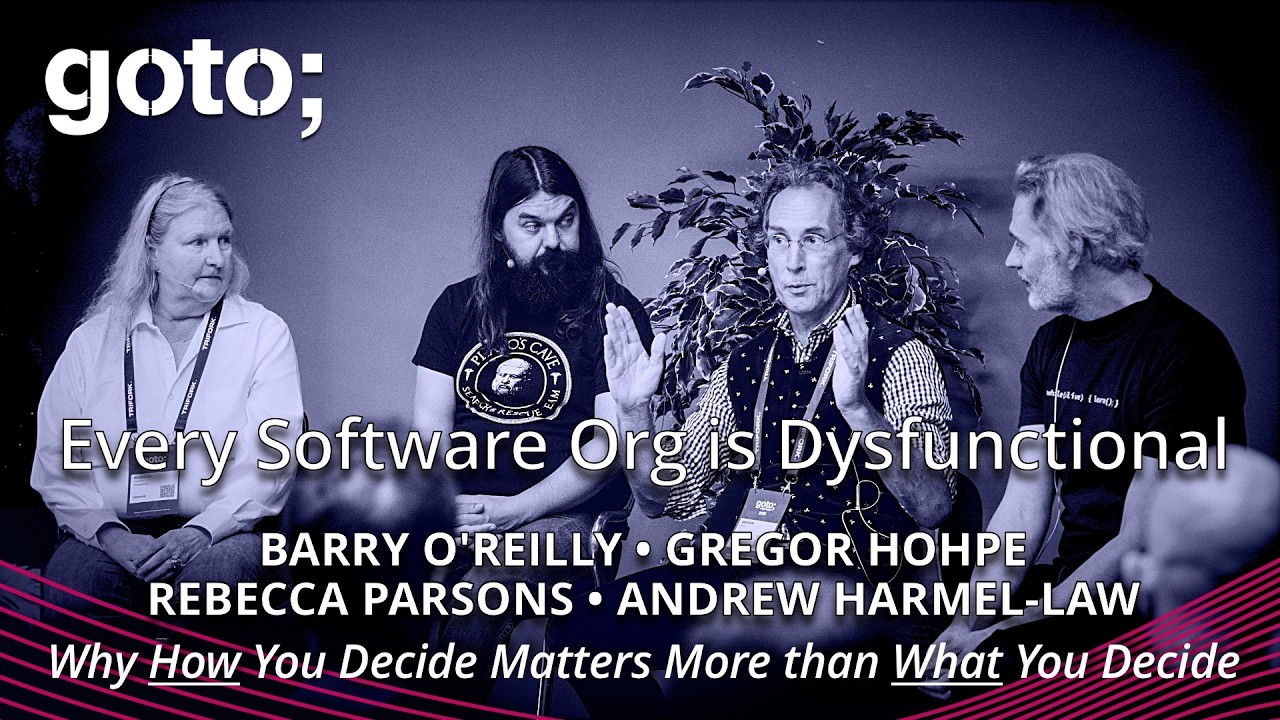
Dysfunction Is the Default State of Software Orgs
Barry O’Reilly answered the opening question flat out: “every organization that builds software is dysfunctional.” The cause is not poor management. Software engineers apply logical-reductive thinking to an irreducibly human world. Gregor Hohpe added that perfection today guarantees imperfection tomorrow, so dysfunction is a standing condition, not a crisis.
Andrew Harmel-Law traced the consequence: architecture on whiteboards and architecture in production code drift apart faster than most teams notice. Tighter feedback from running software back into design — on a fast clock cycle separate from the slow org-change cycle — is what keeps them aligned.
Translating AI Risk into Business Language
Rebecca Parsons drew the line: AI ethics arguments reach the COO and general counsel only when translated into their terms. Reputational harm. Legal liability. The Air Canada ruling, where a court held the company responsible for its chatbot’s false promises, was her example. The court treated the deployed bot as an employee.
Gregor Hohpe added that the choice of architecture is a weaker predictor of outcome than how well that choice is understood and shared across the org. Nine times out of ten, he said, projects fail not because of the wrong decision but because the decision never propagated.
How Disruptive Technology Actually Changes Architecture
Gregor Hohpe used Blade Runner as his frame. The film set its future in November 2019. Six years past that date, there are no flying cars. But the wireless phone — no sci-fi script celebrates removing a wire — reshaped daily life. Big shifts arrive later than expected; small ones hit harder.
Removing a constraint does not remove it from the org. Hohpe’s metaphor: bake a cookie, invent artificial sweetener, and you cannot pull the sugar back out. Companies that moved to cloud brought their hardware procurement approval cycles with them. The constraint left technically. It stayed in every process around it.
Finding the Leverage Point in a Resistant Organization
Gregor Hohpe reframed resistance: people who push back on rapid deployment remember the Friday push that kept the team up all weekend. Their objection is lived proof. Words alone will not shift that.
Barry O’Reilly’s method for crashing projects: take the team off-site, strip all context, build a fake project that teaches them how to interact and design, then put them back. Andrew Harmel-Law’s version: spend the first month watching. Map the human dynamics, find the leverage point. A small change at the right place, as Donella Meadows showed, cascades further than any structural overhaul.
AI Coding Agents Amplify Strengths, Not Gaps
Gregor Hohpe’s read on every new tool: it amplifies what you already do well and rarely fills the gaps. A team with a weak domain model produces more of that weakness when AI generates code. Harmel-Law’s concern is that AI becomes an excuse to stop thinking about requisite complexity.
Barry O’Reilly used an engine-swap metaphor. Fit a bigger engine without upgrading the brakes, and disaster follows. If AI coding agents deliver five times the productivity, everything sized for the previous pace breaks: review processes, pipelines, strategy. The tool does not destabilize software. It destabilizes the organization around it.
Notable Quotes
human world is dysfunctional. Barry O’Reilly · ▶ 5:20
This is the reputational harm from a data breach. Rebecca Parsons · ▶ 8:06
Everything comes back to an integration problem. Gregor Hohpe · ▶ 25:57
Key Takeaways
- Dysfunction in software orgs is structural, not fixable; architects must build systems that survive it.
- AI ethics land with executives only when framed as legal liability, revenue loss, or reputational damage.
- AI tools amplify existing strengths and make existing gaps worse — they rarely compensate for what a team lacks.