 AI
AI
Why Agents Need Deterministic Payments
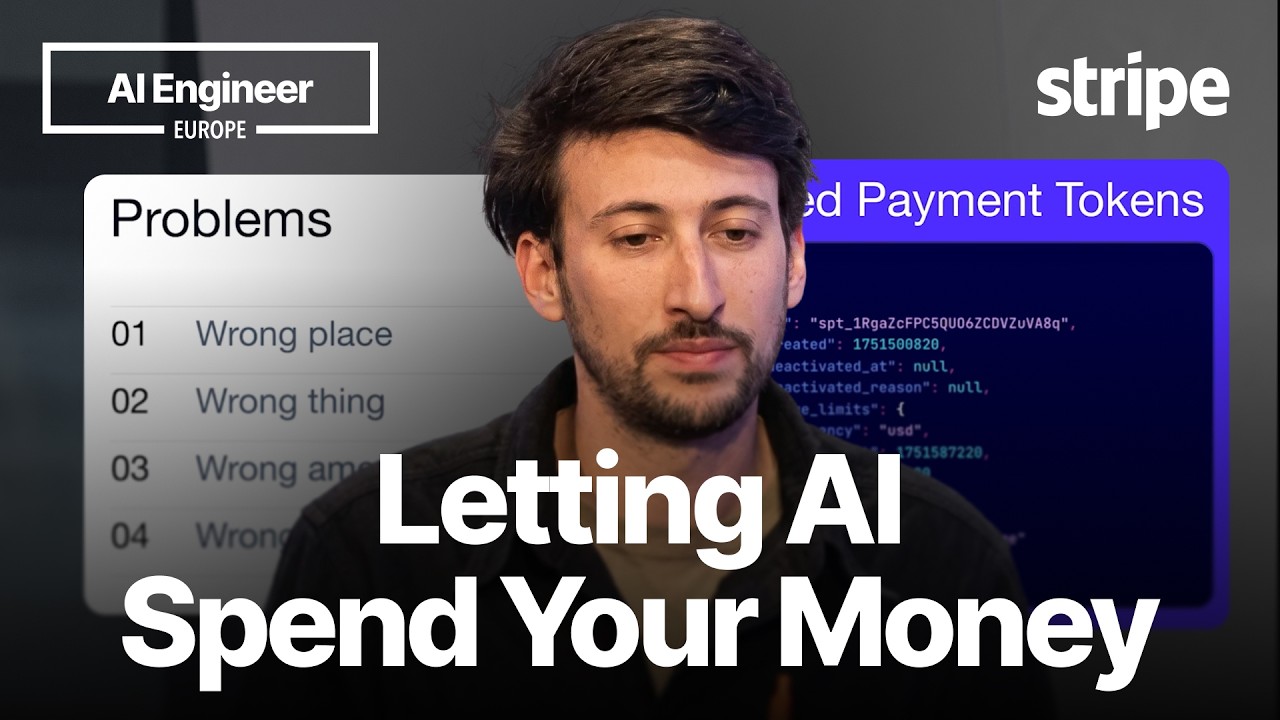
Agents already spend money through tokens and subscriptions. The four risks: buying from the wrong place, buying the wrong thing, spending the wrong amount, using the wrong credential. A browser-automation approach fails because it cannot certify domains, parse prices correctly, or enforce spend limits. Stripe’s solution replaces human-style checkout with API-driven flows that bind to a merchant, enforce policies, and provide verifiable identities.
Shared Payment Tokens Enforce Spend Limits
The demo shows an agent Stripe account creating a shared payment token for a Visa card. The token limits spending to $25, expires in 30 days, and is scoped to a specific seller. When the seller tries to charge $50, Stripe rejects the payment. The seller still sees the card brand and last four digits for their own risk analysis. The blast radius is minimized because the credential carries a mandate that Stripe enforces.
Programmatic Checkout with MCP and ACP
The machine payments protocol lets an agent call a protected HTTP endpoint. The server returns a 402 status code 402 with a payload describing the cost, recipient, and payment method. The agent approves a penny payment on the Tempo blockchain. The agent commerce protocol (built with OpenAI) provides structured JSON for product catalogs, line items, taxes, and shipping. The agent negotiates the cart programmatically, and the seller remains in control of risk signals.
Q&A
How does the shared payment token handle recurring budgets like $25 per week? Kaliski compares it to an OAuth access and refresh flow: the agent can request subsequent usage, or simply create a token with a higher limit scoped to the same seller. ▶ Watch (16:52)
Is Stripe Projects a wrapper around these primitives? Yes, Stripe Projects is built on shared payment tokens and the product-expression ideas. ▶ Watch (17:42)
What is the volume of agent payments so far? No public stats, but Stripe is encouraged and excited to support more businesses. ▶ Watch (18:11)
Notable Quotes
“discovery and exploration benefit from non-determinism, right? So the amazing thing about LMS is huge corpus of information the world’s information can predict and recommend code or products or businesses for you but credentials payments and checkout require determinism” Steve Kaliski · ▶ Watch (0:55)
“agents are already economic actors right they have their own currency and tokens” Steve Kaliski · ▶ Watch (1:38)
“we don’t want the seller to be fully hidden from what’s happening” Steve Kaliski · ▶ Watch (7:33)
“the seller remains in control they continue to have the relationship that they expected to have with customer but also receive the signals and risk data that they need to safely interact with agents” Steve Kaliski · ▶ Watch (14:42)
Key Takeaways
- Shared payment tokens enforce spend limits, expiry, and seller scope at Stripe’s level.
- The machine payments protocol lets agents pay for API calls via blockchain.
- The agent commerce protocol provides structured JSON checkout, eliminating browser-based errors.
- Discovery should stay non-deterministic; payments and credentials must be deterministic.