 AI
AI
Why Incremental Trust Beats Big-Bang Deployment
Radek’s OpenClaw agent now has access to his emails, notes, files, calendars, and OS. It did not arrive that way. He started with a single WhatsApp channel, proved it useful, added one workflow, then the next. That discipline kept failures small: when something broke, he stepped back one step, fixed it, and moved on. The pattern repeated until the setup became more capable than anything he saw on YouTube or Twitter, without any single moment of high-stakes commitment.
A Living Knowledge Base That Connects Itself
The pivot point was a 3,000-note Obsidian vault built over years. When a link lands in the inbox channel, the agent fetches it, analyzes the content, tags it, and cross-links it to existing notes on the same subject. Bookmarks that used to sit unread now surface connections Radek had forgotten. Drop a link and the agent replies: you already had notes on this, here is how they connect. That feedback loop turns passive bookmarking into active knowledge accumulation, and it runs on every item added to the vault.
Five Jobs the Agent Runs While You Sleep
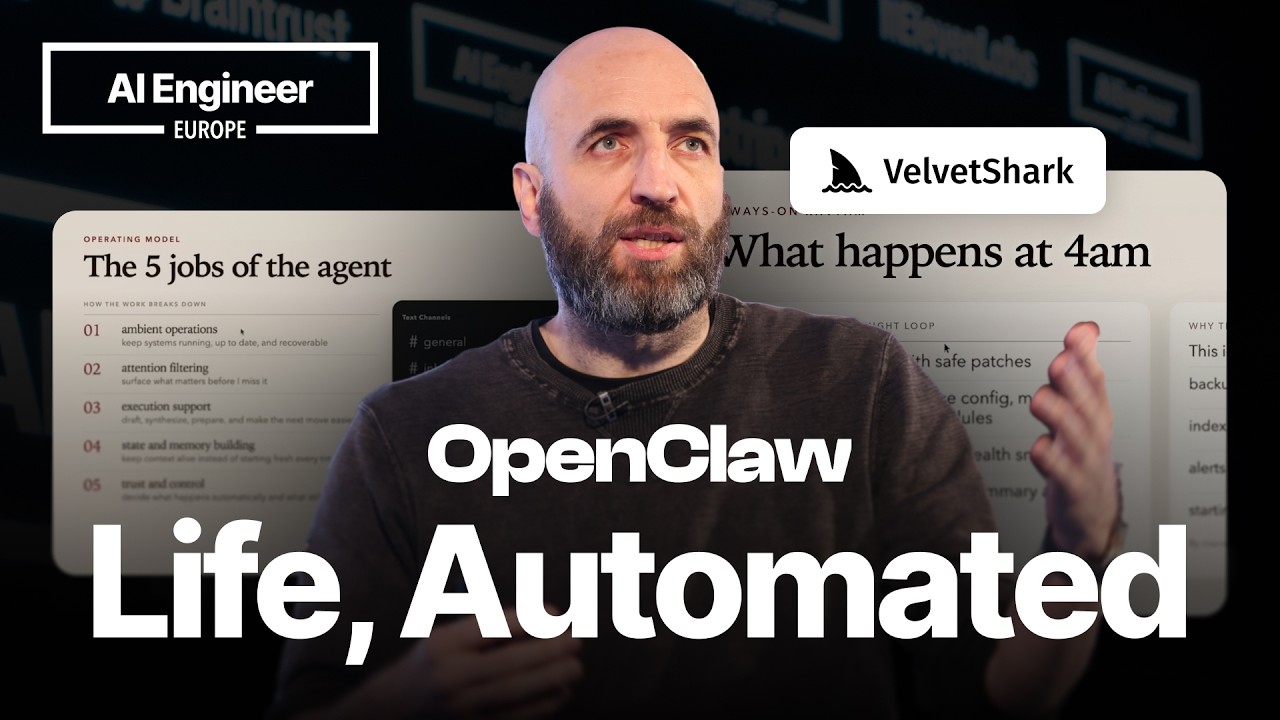
Between 3 a.m. and 6 a.m., the agent runs without supervision. It indexes files, backs up the vault, refreshes QMD and memory indexes, and installs the latest OpenClaw version using scripts that know what can break and how to verify before restarting. By morning a briefing waits: email and calendar summary, system ready. Across five Discord channels (consulting, video research, Instagram, YouTube, open-claw), the agent handles context-aware tasks.
“it’s a system that has many moving parts” — Radek Sienkiewicz
Email drafts with full project context land in the draft folder for a quick accept or delete.
What Degrades and How to Stay Ahead of It
Three failure modes compound quietly. Memory files that grow to thousands of entries without curation degrade judgment over time. Long automation chains (10-step pipelines) will break; splitting them shorter, or adding guard rails, is cheaper than debugging a snapped chain. Noisy nodes require regular cleanup. Radek’s fix for drifting memory: a critical_rules.md file placed high in AGENTS.md so constraints are never missed. His closing advice:
“start with one recurring pain grow trust incrementally” — Radek Sienkiewicz
Move content to markdown, optimize for the person you will be tomorrow, and the system takes care of the rest.
Notable Quotes
start with one recurring pain grow trust incrementally Radek Sienkiewicz · ▶ 17:31
it’s a system that has many moving parts Radek Sienkiewicz · ▶ 14:56
if this happens do this it’s done you don’t Radek Sienkiewicz · ▶ 15:12
Key Takeaways
- Start with one recurring pain point and add one capability at a time to build reliable agent trust.
- A cross-linked markdown knowledge base turns passive bookmarks into an actively surfaced memory system.
- Overnight autonomous operations handle indexing, backups, and email drafts so mornings start ready.