 AI
AI
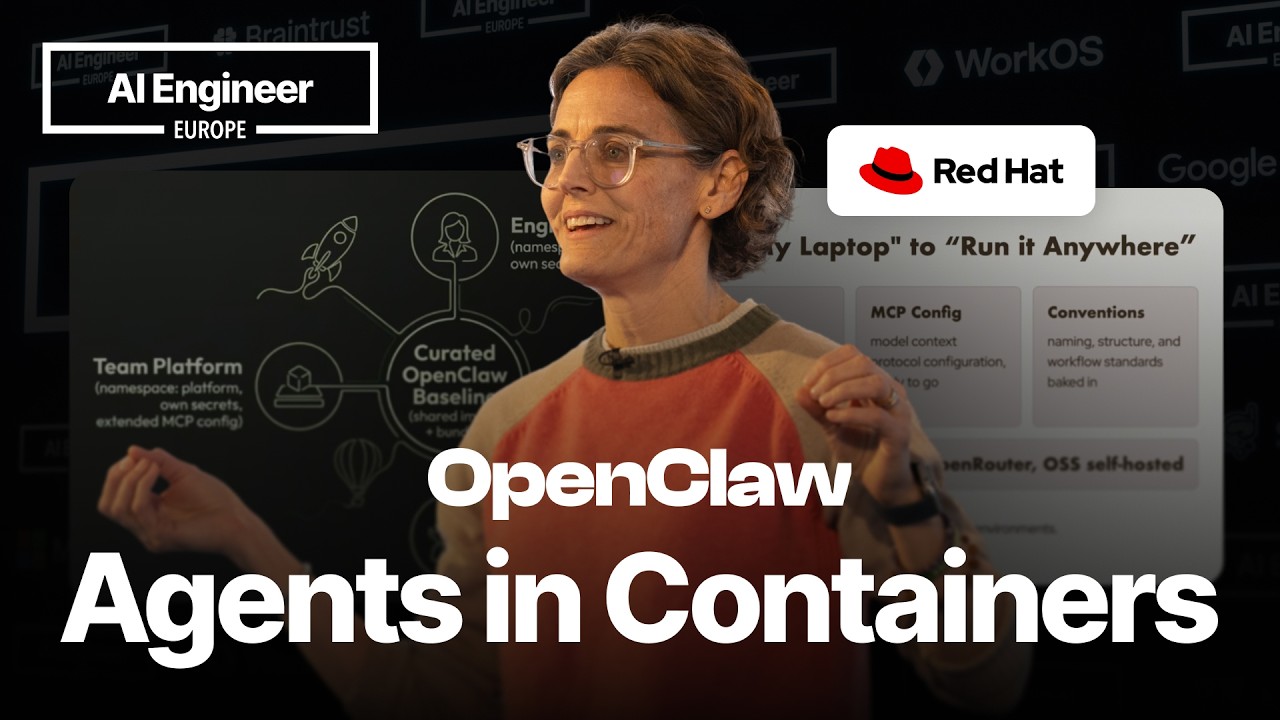
Why Containers Are the Right Runtime for AI Agents
Sally O’Malley runs everything in containers and applied the same logic to OpenClaw. The case is straightforward: a containerized agent is reproducible and portable across x86, Mac, and Kubernetes. Volumes back the state, making backup and recovery a clean story. Containers are also explicit by default about what the host exposes, which is exactly what you want when running an AI agent that calls external APIs. O’Malley’s OpenClaw told her itself: a clean, predictable environment without OS quirks or stale dependencies is precisely why you containerize.
Secrets Management Without Leaking Keys
Podman has a secrets feature that stores API keys as named, contained values rather than plain environment variables. O’Malley mounts those Podman secrets into the container, so the key never sits in a shell env. Inside OpenClaw, she then creates a secret ref that points to the mounted secret rather than embedding the value directly. Two layers of indirection. The keys don’t show up in logs. Kubernetes works the same way: use a secret ref instead of a direct env var binding.
“current credential, create a secret ref.” — Sally Ann O’Malley
From Local Container to Kubernetes at Team Scale
O’Malley develops locally and lifts to Kubernetes unchanged. A friend from Nvidia confirmed the pattern holds at work: 10 engineers each run OpenClaw in Kubernetes, periodically checking in on model evals. One engineer described it as doing the work of six. The container model also makes enterprise onboarding concrete. A new hire gets a baseline image with company-approved MCP servers and pre-configured credentials. They personalize from there. No repo-spelunking on day one.
“And that’s what Kubernetes gives you.” — Sally Ann O’Malley
Live Demo: A One-Command Container Installer
O’Malley built a custom installer that runs with a single npm run dev. Give it a pod name and a port, and it maps pre-existing Podman secrets to OpenClaw secret refs automatically. The Podman secrets live demo (15:56) shows the full flow: named secrets already resident on the system, mapped at container startup, with an optional OpenTelemetry collector backed by Jaeger for tracing. The installer also supports an SSH sandbox that routes OpenClaw’s commands to a remote workspace. She spun up a named instance called Joe in under two seconds.
Notable Quotes
check out OpenClaw. This is so cool. Sally Ann O’Malley · ▶ 2:01
And that’s what Kubernetes gives you. Sally Ann O’Malley · ▶ 8:56
current credential, create a secret ref. Sally Ann O’Malley · ▶ 16:48
Key Takeaways
- Run OpenClaw in a container for reproducible, sandboxed environments with portable state via volumes.
- Chain Podman secrets with OpenClaw secret refs so API keys never appear in logs or plain env vars.
- A containerized agent scales from a laptop to Kubernetes with no config changes, matching what Nvidia’s team does in production.