 AI
AI
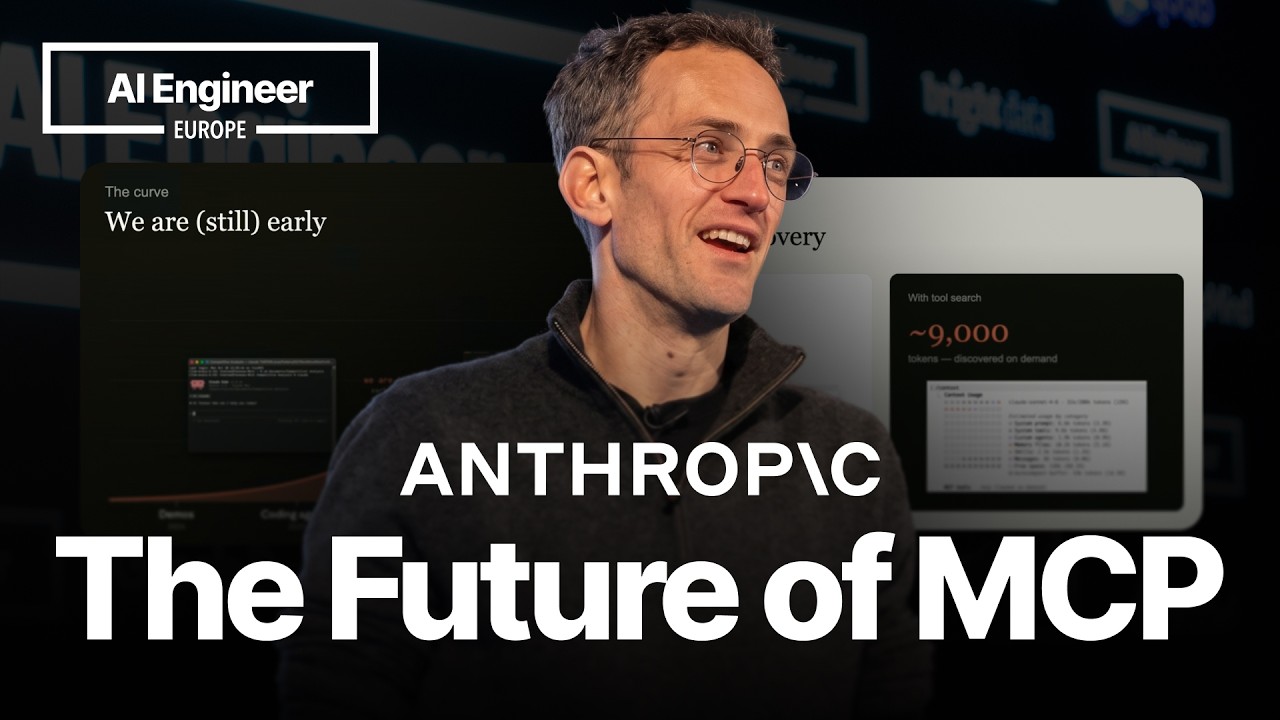
MCP at 110 Million Downloads: What Got Us Here
Eighteen months ago, MCP was a spec document, a few SDKs mostly written by Claude, and nothing else. Now it sits at 110 million monthly downloads. React, one of the most successful open-source projects of the last decade, took roughly twice as long to reach that volume. OpenAI’s Agent SDK, Google’s ADK, LangChain, and thousands of other frameworks pull MCP as a dependency. There is now one common wire standard across the industry. Soria Parra’s read: 2024 was demos, 2025 was coding agents, and 2026 is when agents move into real knowledge-worker territory.
Connectivity Is Not One Thing: Skills, CLIs, and MCP
General agents connecting to five SaaS apps and a shared drive need connectivity above everything else. Soria Parra argues no single solution covers this. Skills encode domain knowledge in a portable file. CLIs work well for local coding agents that can assume a sandbox and call Git or GitHub, which the model already knows from pre-training. MCP handles the rest: long-running tasks, authorization, governance, platform independence, and the richer semantics that enterprise deployments require. The right call depends on the scenario.
Progressive Discovery and Programmatic Tool Calling
Most MCP clients today dump every tool into the context window and then complain when it fills up. Progressive discovery fixes this: give the model a tool-search function, load tools on demand, and the context stays lean. Anthropic’s API supports this directly, and Claude Code ships a Claude Code progressive discovery before/after showing the drop in tool context usage. The second fix is programmatic tool calling. Chaining tool calls through inference is slow. Let the model write a small script instead, execute it in a V8 isolate or equivalent, and the tools compose without the round-trip cost.
What the Protocol Still Needs to Fix
Mapping REST endpoints one-to-one into MCP tools produces bad results. Design tools the way a human would use them. The June 2026 spec brings three fixes: a stateless transport from Google so MCP servers deploy to Cloud Run or Kubernetes like any REST service; cross-app access so agents work after a single Okta or Google login; and server auto-discovery via well-known URLs. TypeScript SDK v2 and Python SDK v2 also ship, and skills over MCP will let server authors push updated domain knowledge without touching registries.
“Things that only MCP can do for you.” — David Soria Parra
Notable Quotes
our agents kind of still suck. David Soria Parra · ▶ 7:34
we’re now like at 110 million David Soria Parra · ▶ 2:42
Things that only MCP can do for you. David Soria Parra · ▶ 13:33
Key Takeaways
- Progressive discovery defers tool loading until needed, cutting the context window bloat that stalls most MCP setups today.
- Mapping REST endpoints one-to-one into MCP tools produces bad results; design tools the way a human would want to use them.
- The June 2026 spec ships stateless transport, server auto-discovery, and cross-app SSO — the infrastructure general agents need.