 AI
AI
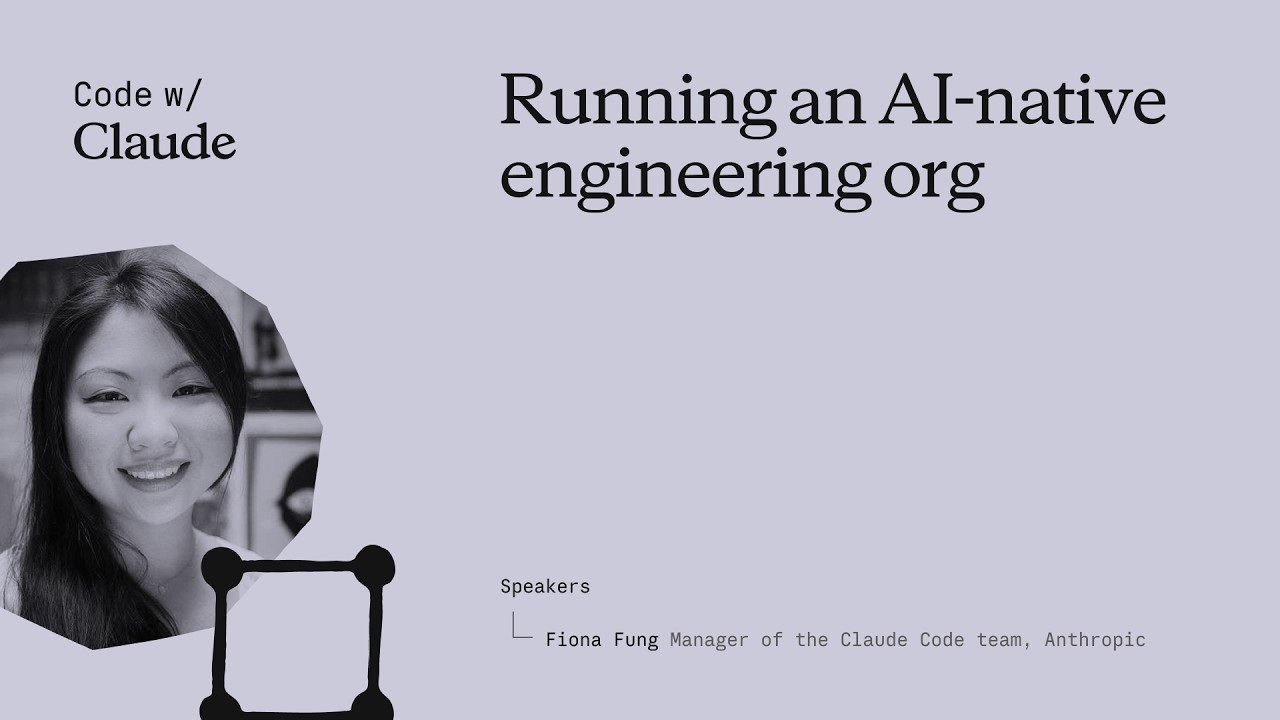
How Bottlenecks Shifted from Coding to Verification
For years, engineering bandwidth was the expensive constraint. Waterfall, then agile, every planning methodology assumed coding time was scarce. That assumption no longer holds. On the Claude Code team, coding is rarely the slow part. The new bottlenecks are verification, code review, cross-functional partners, and security. More code gets generated than before, which also raises the maintenance question. Fung’s diagnosis: when throughput increases sharply, the surrounding pipeline, not the coding itself, becomes where work piles up.
JIT Planning and Settling Debates With Code
A six-month roadmap lasted three months before it needed a full rewrite. Now the team plans just-in-time, generating prototypes instead of writing specs. Technical debates changed too. Fung and a colleague disagreed on a refactoring approach, nearly retreating to a whiteboard. Instead, she generated three PRs showing each option, including how each would affect callers into the API. The debate became concrete. When building is cheap, prototyping wins the argument. The risk: without team culture around alignment, whoever has the last commit wins.
Where Claude Reviews and Where Humans Stay
Claude handles styling, lint, PR feedback requests, bug-catching, and adding tests. It babysits PRs before a full commit. That frees human reviewers from high-volume, low-stakes checks. Some areas still require a human: legal review, security-sensitive code and trust boundaries, and product taste. The taste example is instructive. Fung asked Claude to redesign the terminal prompt as a holiday snowman. A design partner spotted the problem: it looked like Mr. Peanut. Claude wasn’t good at ASCII art yet. Taste needs a person.
Hiring for Product Sense and Systems Depth, Not Throughput
Two profiles matter at hiring time: creative builders with product sense, and engineers with deep systems expertise. When Fung joined, the team was strong on generalists but short on distributed systems depth. Building Claude Code Remote, which runs Claude instances at scale, required that expertise. Raw throughput is no longer the hiring signal. The org is flat. Every manager joins as an IC first, ships real code, and earns credibility before managing. Recruiters said no manager would accept that. The requirement stayed.
Three Metrics That Show When Changes Are Working
Onboarding ramp-up time and PR cycle time should both drop. Claude-assisted commits should rise. On the Claude Code team, every commit is Claude-assisted. Fung hasn’t seen a non-Claude-assisted commit in four months. But she flags a common mismeasurement: headlines about AI-generated code percentages miss the real target. PR cycle time can also expose pipeline bottlenecks beyond AI adoption, like CI infrastructure that can’t keep pace with higher commit volume. The signal worth watching is quality and reliability, not throughput percentage.
Notable Quotes
So, in technical debates, code wins. Fiona Fung · ▶ 9:09
trust but verify. Fiona Fung · ▶ 14:38
the code is the source of truth. Fiona Fung · ▶ 19:58
Key Takeaways
- Coding throughput is no longer the bottleneck; verification, review, and cross-functional scaling are.
- Generate competing implementations instead of whiteboarding; code wins technical debates faster than argument.
- Every manager on the Claude Code team starts as an IC to earn credibility through dogfooding.
- Build explicit permission to kill outdated processes into team norms; processes rarely self-terminate.
- Measure quality and reliability, not the percentage of AI-generated code.